
Vietnamese lenders are providing more pledges to cover borrowers if they fall short paying back debt, prompting some rating firms to warn of hidden risks in one of the world’s fastest-growing economies.
Banks’ loan guarantees rose 19% to 52 trillion Vietnamese dong ($2 billion) in the first nine months of last year, according to data compiled by VIS Rating on 27 listed lenders. That outpaced a 13% rise in their total equity over the same period last year, adding to a similar mismatch in 2024.
That dynamic is being closely monitored because Vietnamese banks are already operating with thin capital buffers to absorb potential losses. Standby letters of credit (SBLCs)—a promise to repay debt if the client borrower can’t—have been a popular way to make guarantees. They are kept off-balance sheet and not broken out in overall data, increasing the chances of surprises if borrowers stumble. In China, regulators have in recent years told some lenders to limit their use of such arrangements.
Hidden risks from SBLCs may weaken loss-absorption buffers, especially as banks’ capital raising remains limited, said Phan Duy Hung, director-senior analyst at VIS Rating.
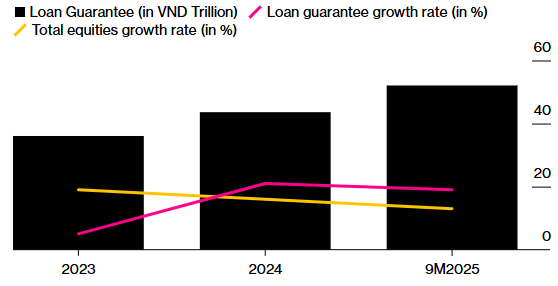
Source: VIS Rating
Vietnam needs to balance economic growth targets of at least 10% on average over the next five years with steps to curtail side effects from debt-fueled expansion. Major defaults in recent years, including at developer Novaland Investment Group, underscored the risks. More recently, the rapid pace of lending has come under more scrutiny, including from Fitch Ratings, which has warned of high leverage.
Authorities have also voiced concern about credit growth. Earlier this month, the central bank cut its target for credit expansion to about 15% this year, after taking steps in recent months to limit credit to riskier sectors.
As they search for more debt financing, Vietnamese borrowers benefit from using SBLCs as the structure can provide a way for them to access funding from global lenders at costs only possible with secured loans. The standby letters of credit from local banks can potentially bring companies a cost savings of as much as about 500 basis points, compared with borrowing directly offshore, some investors say.
The overseas lenders are often willing to extend money with such terms because they are getting a promise to be made whole if the borrower defaults.
Vietnamese conglomerate Vingroup JSC is among the groups that have tapped into such structures to back offshore borrowings, according to people familiar with the matter, who asked not to be identified because the deal is private.
Vingroup’s electric vehicle maker VinFast Auto Ltd. secured a $510 million private credit loan from lenders including Deutsche Bank AG and alternative investment firm SeaTown Holdings International in 2025. The facility is backed by several SBLCs issued by Vietnamese banks, they said. Vingroup considers “a range of funding sources, including SBLCs,” it said in reply to a query on the financing. Deutsche Bank and SeaTown declined to comment.
In another example, premier luxury real estate developer SonKim Land obtained $200 million in private credit from an undisclosed investor last year. The facility was backed by an SBLC issued by a local lender, the people said. SonKim declined to comment.
There are no indications of any payment issues with those deals. A representative of Vietnam Banks Association declined to comment when asked about the risks of guarantees such as SBLCs.
More generally, rapid credit growth and thin capitalization make Vietnam’s banks more vulnerable than regional peers in the event of any new economic shock, according to Willie Tanoto, a senior director in Fitch Ratings’ Asia-Pacific Financial Institutions team.
Banks’ tier 1 capital ratio - a measure of financial strength comparing core equity capital to total risk-weighted assets - was estimated to be 9.5% last year, versus 23% for banks in Indonesia, 17.5% for lenders in Thailand, and 15.6% for those in Malaysia, according to data from Fitch.
— With assistance from Harry Suhartono and Nguyen Dieu Tu Uyen
(Updates with more explanation and details.)
See more at: bloomberg.com
